
Never Run Out of Content

Why I Do This
Most business owners I meet don’t have a content problem.
They have a time problem.
Every morning starts with the same question: “What should I post today?”
So they write something quickly, publish it, and start again tomorrow.
That’s the content treadmill. It’s tiring, and it rarely brings in business.
So this is the first thing I teach about content strategy:
Stop creating more content. Get more out of the content you already create.
I call it the content waterfall.
You create one strong piece of content, then let it flow down into smaller pieces for every platform you use.
It’s my basic content strategy, and it’s how you never run out of content again.
My content waterfall in four numbers
1
idea worth multiplying
1
anchor piece with your complete thinking
10+
insights pulled out of that anchor
20+
posts, carousels, reels and emails
How I Actually Work
Here’s the content waterfall exactly as I teach it.
Eight steps. One idea at the top. A business enquiry at the bottom.
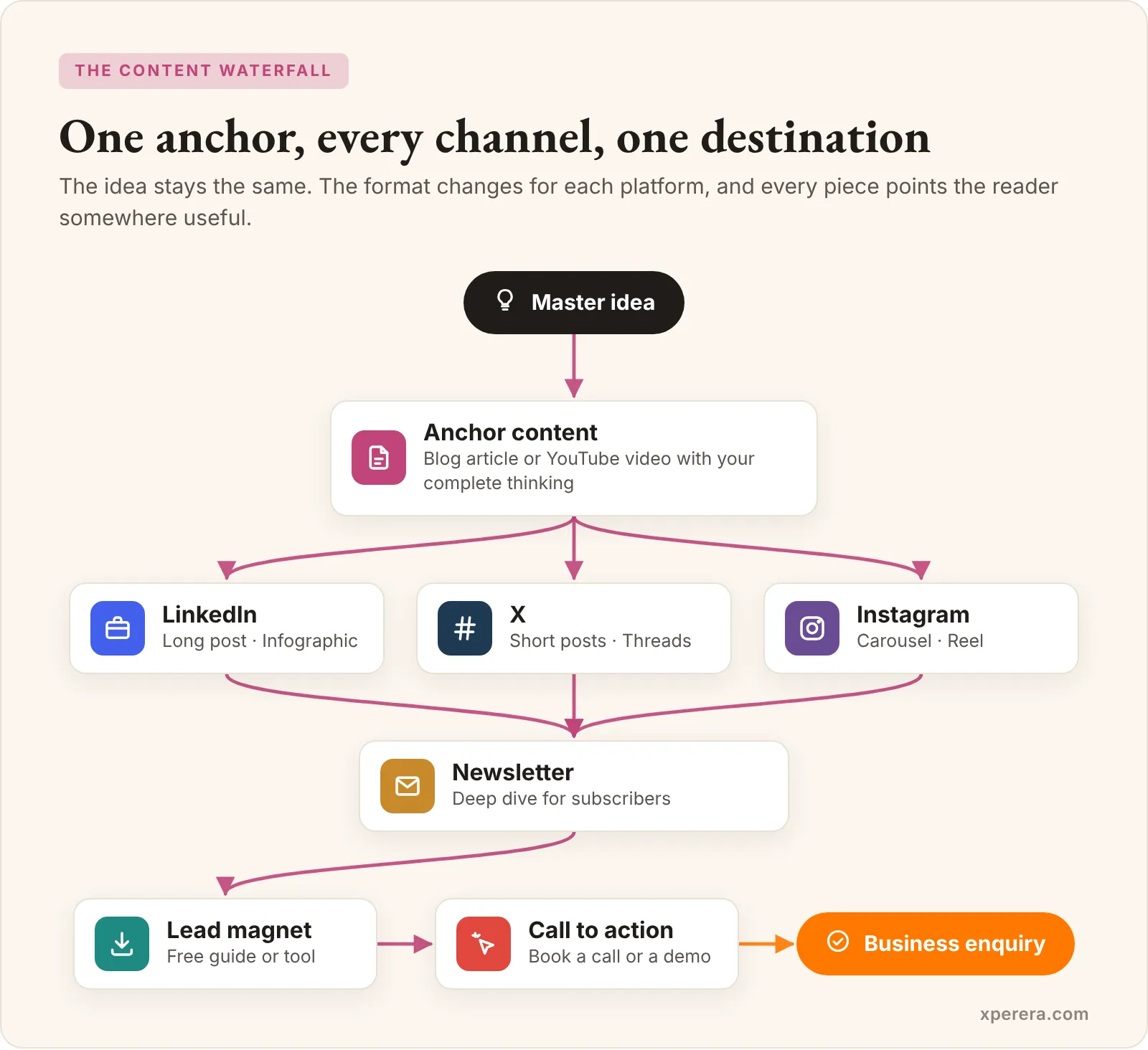
Start With What You Want People to Know
Don’t start with “What should I post today?”
Start with “What do I want my audience to know, believe or do?”
Your answers become five to seven content pillars. That’s your idea bank.
Every client question, test and lesson from your own work goes into it.
Only Waterfall What Has Earned It
Not every post deserves to be multiplied.
Look for your outliers: posts with unusual engagement, topics that brought enquiries, questions people keep asking.
No data yet? Start with the question clients ask you most.
Build One Strong Anchor
The anchor is the most complete version of your idea: a 1,500-word article or a 10-minute video.
I teach a simple structure: problem, evidence, examples, case study, solution, conclusion.
Everything else flows from it.
Extract the Ideas Inside It
This is where AI earns its place.
Don’t ask it to “write 20 posts”. You’ll get 20 generic posts.
Ask it to list every standalone idea, statistic and opinion in your anchor. One article usually gives you ten.
Adapt the Format, Not the Idea
Don’t copy the same paragraph everywhere.
The idea stays the same. The packaging changes.
A sharp argument on X. A personal story on LinkedIn. A slide-by-slide carousel on Instagram. A deep dive in your newsletter.
Give It Somewhere to Go
A waterfall that ends in likes is just a busier treadmill.
Each cluster moves people one step: awareness, education, trust, authority, then a clear call to action.
That’s when content turns into enquiries.
See It on One Real Anchor
Here’s what one anchor looks like after the waterfall.
Take my article How AI Workflows Can Cut Admin Time for a Small Business.
From that single article, we pull out pieces like these:
- LinkedIn post: “Most SMEs are using AI wrong.” A short, personal take on why buying AI isn’t the same as using it well.
- X post: “Buying ChatGPT isn’t an AI strategy.” One sharp line and one reason.
- Instagram carousel: “5 admin tasks your business should automate.” A hook slide, one task per slide, then a recommendation.
- Instagram Reel: “If someone on your team copies information from email into Excel every day, you have an automation opportunity.”
- LinkedIn case study: one workflow, before and after.
- X thread: the five steps to build your first workflow.
- Newsletter: “The AI workflow that could give your team hours back every week.”
- YouTube video: “How to build an AI admin workflow for your small business.”
That’s eight pieces from one article.
And we haven’t touched the statistics or the opinions inside it yet.
Every piece uses the same idea in a different package, and every piece points back to the full article.
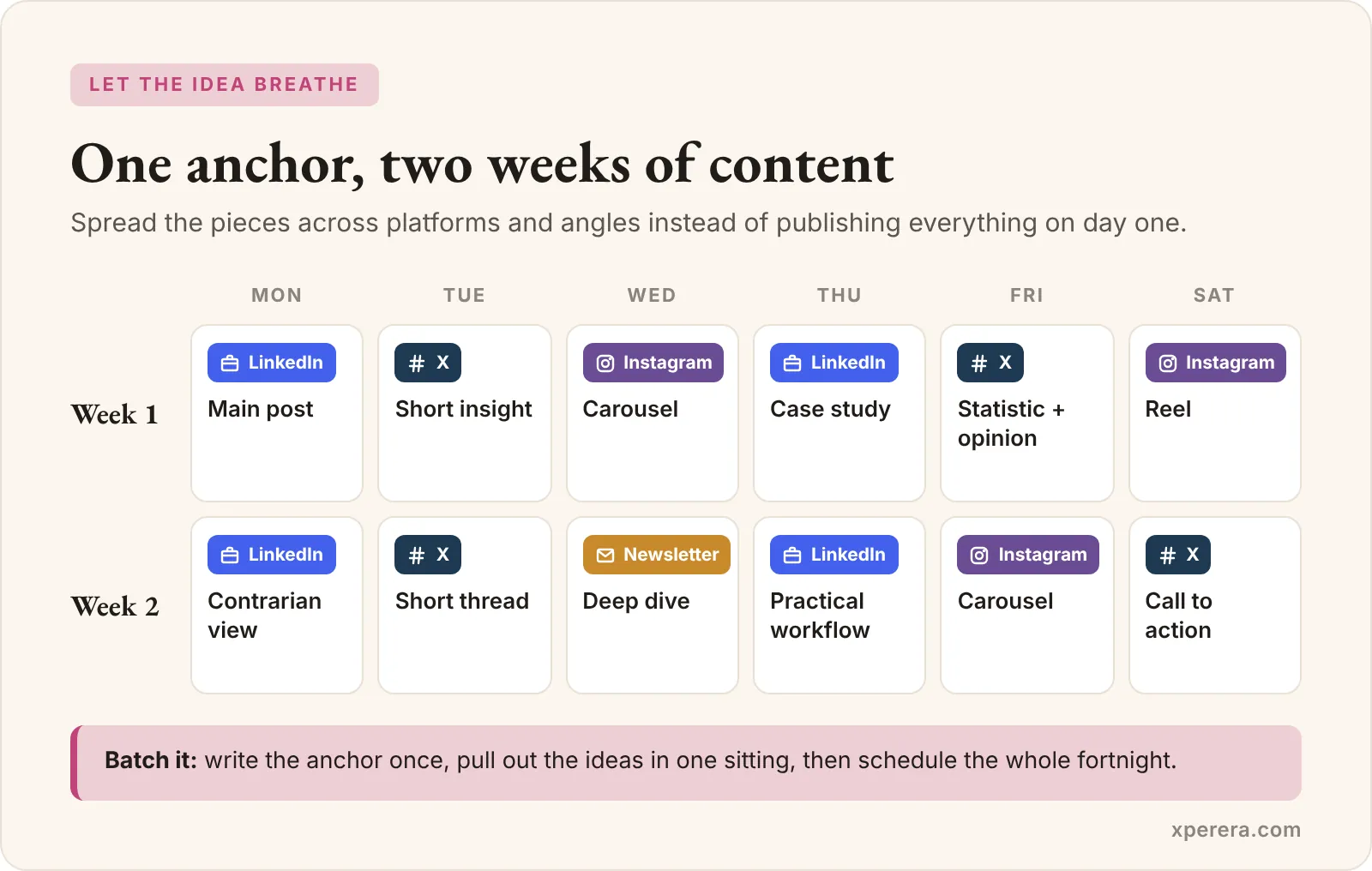
Let the Idea Breathe
You don’t need to publish everything on day one.
One anchor spreads across two weeks, mixing platforms and angles.
We batch the work: write the anchor once, pull out the ideas in one sitting, then schedule the whole fortnight.
That’s how you build a backlog instead of starting from zero every morning.
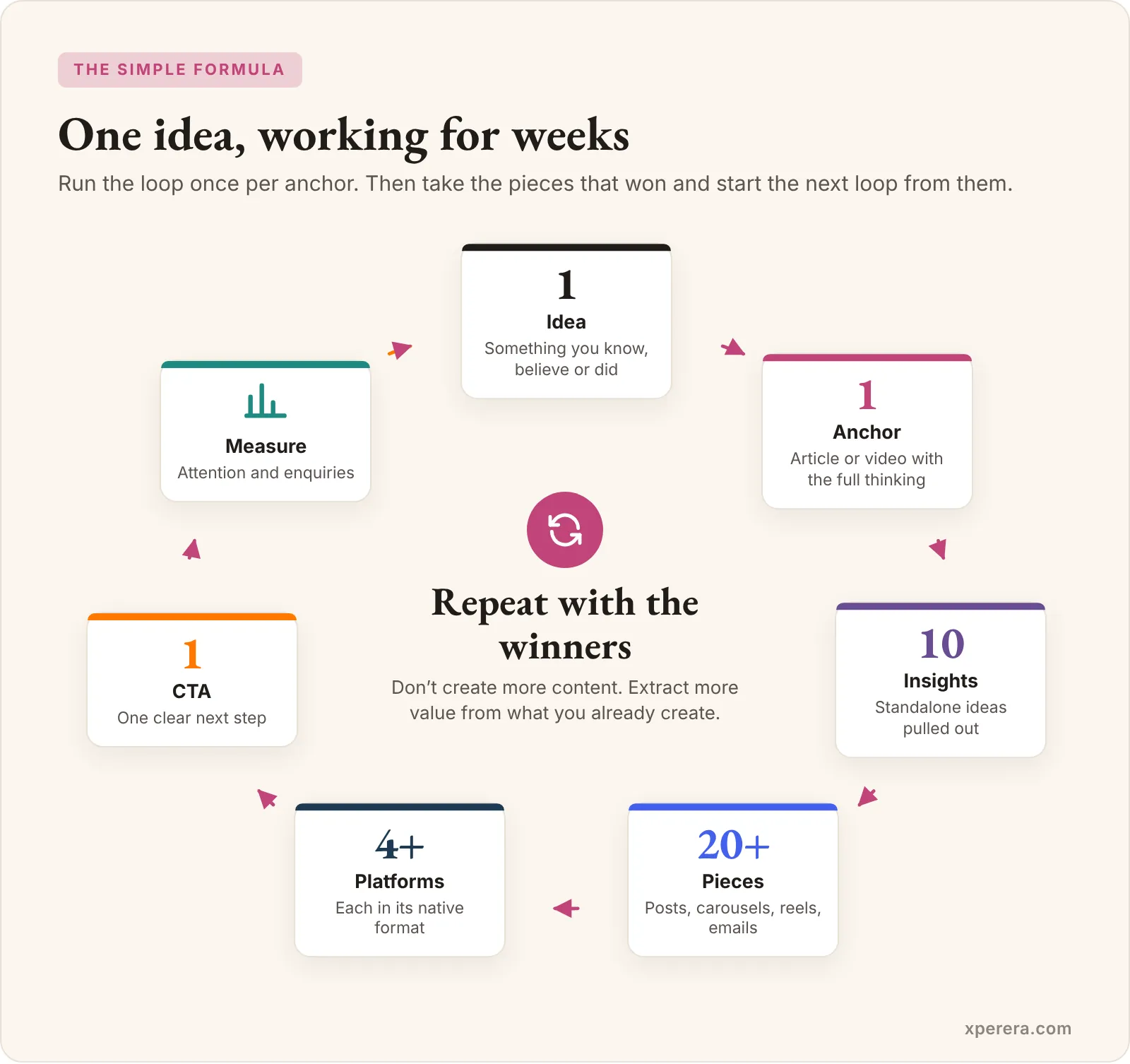
Measure, Then Repeat With the Winners
Likes and views tell you what got attention.
Enquiries, subscribers and sales tell you what brought in business.
We track both.
Then we take the pieces that won and start the next waterfall from them. One winner can become a whole content family.
What I Bring
When I teach this, we don’t stop at theory.
We build your first waterfall together, so you leave with a working system you can repeat on your own.
Your Content Pillars and Idea Bank
Five to seven themes that fit your business.
Plus a running list of ideas from your own work, so the next post is never a blank page.
Your First Anchor, Fully Extracted
One strong piece, broken into 10+ insights.
Plus the AI prompts to do the extraction yourself next time.
A Two-Week Plan You Can Repeat
A simple calendar across the platforms you actually use.
Plus the few numbers worth tracking, so you know what to waterfall next.
Frequently Asked Questions
What is a content waterfall?
A content waterfall is a content strategy where one strong anchor piece, such as a long article or video, is broken into smaller pieces for each platform: LinkedIn posts, X posts, carousels, Reels and newsletters. The idea stays the same, while the format changes for each platform.
How many pieces of content can one anchor create?
A well-researched 1,500-word article usually holds 10 or more standalone insights. Each insight can become several posts, so 20 or more pieces from one anchor is realistic.
Is a content waterfall the same as posting the same thing everywhere?
No. Copying the same text to every platform is cross-posting. A waterfall keeps the idea but rewrites it in the format each platform rewards, such as a short argument on X or a slide-by-slide carousel on Instagram.
Do I need AI to run a content waterfall?
No, but it helps. AI is fast at pulling the individual ideas out of your anchor and drafting first versions for each platform. Your own experience stays at the source, and you review every piece before it goes out.
Want your own content waterfall running?
Book a 20-minute call and we’ll look at where your best ideas are hiding, and which one to waterfall first.